

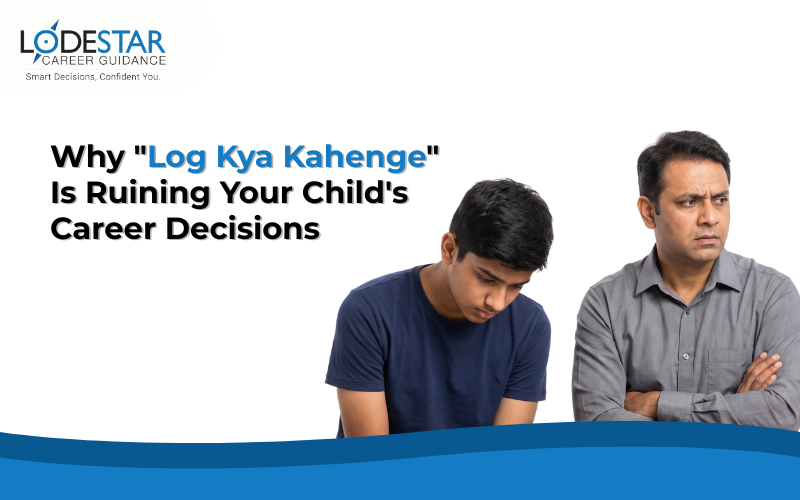
Every Indian family knows this question. Your child mentions design, or psychology, or sports management, and before you have even thought it through, a second voice starts up in your head. What will your brother-in-law say? What will the neighbours think when they ask what your child is studying?
That worry comes from love. You want your child to be respected as well as secure. But when relatives and society end up deciding the career, your child pays for it in motivation, confidence, and years spent in work that was never suited to them. This guide is about untangling those two things.
Not sure what actually suits your child? The free quick test takes a few minutes and gives you an answer based on evidence, not opinions. Take the Free Quick Test
How Social Approval Quietly Takes Over
The pressure is rarely direct. Nobody announces that a child must become an engineer. It arrives as a comment at a wedding, a comparison with a cousin, a raised eyebrow when an unfamiliar career is mentioned.
- A child interested in animation, psychology, or digital marketing gets nudged toward medicine or engineering because those are easier to explain to relatives.
- Over time the child stops mentioning what genuinely interests them, because it always invites an argument.
- The decision gets made on what sounds respectable, not on what your child is actually built for.
The cost shows up later, in a degree half-finished or a job left within two years.
Replace Opinions With Something Better
The answer to social pressure is not to swing the other way and let your child chase whatever sounds exciting. That is just a different kind of guesswork. The answer is data.
A career decision should rest on three connected factors, often shortened to PIA: Personality, Interest, and Aptitude.
- Personality means your child’s vocational personality, the tasks and roles they are naturally suited to, measured using the Holland Code.
- Interest is what genuinely pulls them in, seen in the activities they return to without being pushed.
- Aptitude is natural ability across numerical, verbal, spatial, reasoning, and mechanical areas, with academic ability sitting inside this rather than apart from it.
Personality carries the most weight, then interest, then aptitude. Once you have that picture, the conversation changes completely. You are no longer defending a choice to relatives. You are explaining what the assessment showed.
Today’s Respected Careers Are Not the Same Ones
Part of the problem is that the list of “acceptable” careers in most families was fixed thirty years ago. The working world has moved on considerably since then.
- Artificial intelligence and machine learning are the fastest-growing fields right now, with dedicated degrees and demand well ahead of supply.
- Data science, cybersecurity, and UX design have become serious, well-paid professions.
- Psychology, environmental science, and content and media roles now offer real career progression.
- Genetics, forensic science, and material science sit well beyond the usual engineering and medicine conversation.
Many of these barely existed when you were choosing your own path. A relative’s confident opinion about them is worth very little.
What to Say Instead
Changing a mindset this old takes time, but the words you use every day shift things faster than you might expect.
- Instead of “people will laugh at this,” try “let us understand what this field actually involves.”
- Instead of “what will relatives think?”, ask “does this match your strengths and where you want to be?”
- Instead of comparing your child with a cousin, ask what they are proud of doing.
Celebrate effort rather than ranking achievements. A child who is compared constantly stops sharing anything honest.
Get the Order Right, Then the Explaining Gets Easy
Most families choose a stream after Class 10 and go looking for a career inside it. Reverse that, and much of the social pressure loses its grip.
- Decide the career first, and the stream follows from it. A child suited to microbiology arrives at science. One suited to economics arrives at commerce with maths.
- Class 10 is where this really counts, since the career decided then sets the stream and the years of preparation ahead.
- Around 70 percent of students who go through structured guidance follow the path it identifies.
When a decision is backed by an assessment and a counsellor’s report, it stops being your opinion against your uncle’s. That alone settles most family arguments.
Decide With Evidence, Not Opinions, With Lodestar
The strongest answer to “log kya kahenge” is a decision you can actually defend. Lodestar is India’s first scientific career guidance company, with more than 10 years of experience and over 60,000 students guided, of whom more than 90 percent rated the service highly. Your child takes an online assessment from home, built on their Personality, Interest, and Aptitude. You receive a detailed report and one-to-one counselling sessions you attend together, ending in a clear Plan A and Plan B.
Want a simple first step? Take the free quick test to see where your child’s strengths point, or book a Lodestar career guidance session to plan the right path with confidence.
Frequently Asked Questions
How does social pressure affect my child’s career?
It pushes children toward careers that are easy to explain rather than ones that suit them. The result is usually lower motivation, weaker confidence, and a path abandoned partway through.
Should I let my child choose any career they want?
Not blindly, and not by committee either. Guide them using a scientific assessment of their personality, interest, and aptitude, then decide together. That is very different from either handing down a career or leaving them to guess.
My child wants a career nobody in our family understands. What now?
Learn about it together rather than dismissing it. Look at what the work actually involves day to day, the pathways in, and where the field is heading. Most fears shrink once real information replaces assumption.
How do I answer relatives who question our decision?
Explain the reasoning rather than the career. A decision built on an assessment report is far easier to stand behind than one built on instinct, and it usually ends the questioning quickly.
Will an unconventional career hurt my child’s future?
Not if it fits them. Fields like artificial intelligence, design, psychology, and data science are neither unconventional nor risky anymore. What genuinely hurts a career is spending years in work your child was never suited to.
When should we make this decision properly?
Class 10 is the ideal point, since the career decided then shapes the stream and the preparation that follows. If you miss the Class 10 window, it can still be done in Class 11 or 12.
